Video Poker Paytables Decoded: Key Variations and Their Impact on Payouts
Elena Berger · Apr 8, 2026
Video Poker Paytables Decoded: Key Variations and Their Impact on Payouts
The Basics of Video Poker Paytables
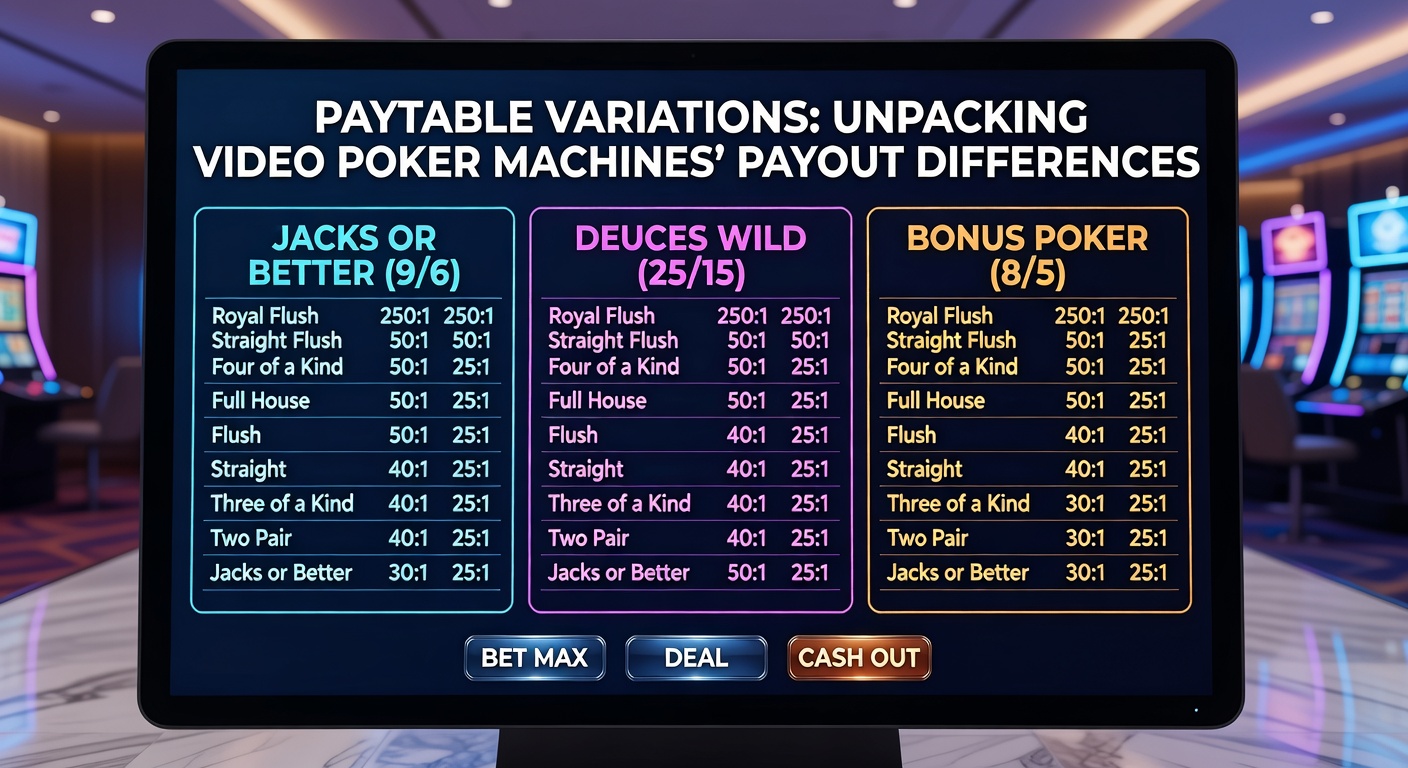
Video poker machines operate on fixed paytables that dictate payouts for every possible hand, from a pair of jacks up to a royal flush; these tables form the backbone of the game's return to player (RTP) percentage, which typically ranges from 95% to 99.5% depending on the variant and configuration. Players draw five cards, choose which to hold, and aim to form the strongest hand listed on the paytable, but what's interesting is how even small changes in those payout tiers—say, dropping from nine coins for a full house to eight—can shave entire percentage points off the overall RTP. Experts who analyze casino floors note that full-pay tables, often called 9/6 Jacks or Better because they award nine coins for a full house and six for a flush on a five-coin bet, deliver around 99.54% RTP with perfect strategy, while short-pay versions like 8/5 Jacks or Better fall to about 97.3%, making the difference between a game that's nearly break-even and one that's squarely house-favored.
Manufacturers such as IGT and Aristocrat design these paytables to balance player appeal with casino profitability; regulators in places like Nevada approve them only after rigorous testing to ensure fairness, yet casinos retain flexibility to select from approved variants. Data from Wizard of Odds analyses reveals that over 80% of video poker machines in Las Vegas Strip casinos feature subpar paytables below 98% RTP, whereas off-Strip venues and locals' markets often host better ones, drawing savvy players who hunt for those edges.
Common Paytable Types Across Popular Variants
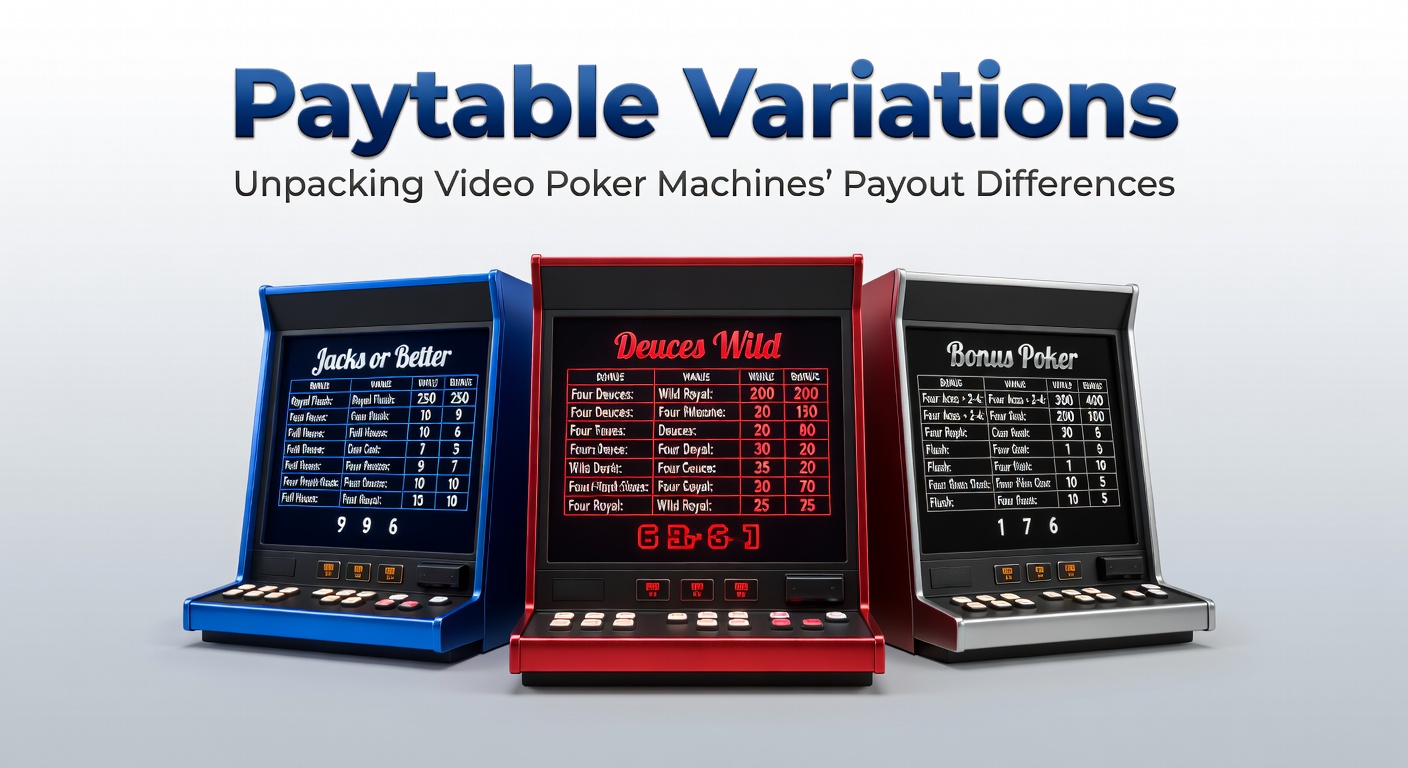
Jacks or Better remains the most widespread video poker game, with paytable variations distinguished primarily by payouts for flushes, full houses, and straights; a true full-pay 9/6 version pays 9-for-1 on full houses, 6-for-1 on flushes, 4-for-1 on straights, and 1-for-1 on low pairs, but 7/5 tables reduce those to seven for full houses and five for flushes, dropping RTP to 96.15%, and even worse 6/5 configurations hover around 94.01%. Deuces Wild introduces wild cards that reshape paytables entirely, where full-pay machines pay 15-for-1 on natural royal flushes, 9-for-1 on four deuces, and 4-for-1 on wild royals, yielding up to 100.76% RTP—meaning players can mathematically gain an edge—yet not-so-full-pay versions like those paying 12 for four deuces plummet to 97.58%.
Bonus Poker variants spice things up with higher payouts for four-of-a-kind hands based on rank; for instance, full-pay Bonus Poker Deluxe offers 80% RTP on Jacks or Better equivalents but boosts four aces to 80-for-1 and four 2s-4s to 40-for-1, while Double Bonus ramps that even further with 60-for-1 on four aces and 50-for-1 on four 2s-4s, though strategy shifts accordingly since chasing those bonuses increases volatility. Observers on casino floors point out that Double Double Bonus, paying 160-for-1 on four aces with a kicker, can hit 100.07% RTP on full-pay tables, but casinos rarely deploy them without shortening other tiers. And then there's Joker Poker, where the joker acts as a wild; full-pay versions pay 100-for-1 on natural royals and 80-for-1 on five-of-a-kind, pushing RTP over 100%, although five-of-a-kind jokers often get nerfed in common setups.
What's significant here is regional clustering; figures from the Nevada Gaming Control Board show that in 2025, Reno-area casinos averaged higher RTPs across video poker banks compared to the Strip, with 9/6 Jacks or Better comprising 15% of machines versus under 5% on the main drag.
RTP Impacts and Strategy Adjustments
Paytable variations don't just alter raw returns; they demand tailored strategies, as optimal play charts shift with payout structures—for example, in 9/6 Jacks or Better, holding four to a royal flush trumps most other draws, but in an 8/5 version, the math flips toward safer plays like low pairs more often. Research compiled by gaming mathematicians indicates that imperfect strategy on a full-pay table costs players about 0.5% in RTP, yet on short-pay machines, basic errors compound faster due to lower baseline returns; take one case where a player in an Atlantic City casino chased high-variance hands on a 7/5 Deuces Wild machine, only to discover post-session analysis that switching to a nearby 9/6 Jacks or Better would have boosted expected value by 2.5% per hand.
Volatility plays a role too, since bonus-heavy paytables like Double Double Bonus deliver wild swings—royal flushes might pay 4,000 coins, but dry spells drag sessions longer—while conservative 9/6 setups offer steadier small wins. Players who've tracked thousands of hours via apps note that full-pay hunting turns video poker into a skill game where edges compound over time; data shows a disciplined player on 99.5% RTP machines can expect $1 hourly loss on $1/quarter machines with perfect play, but that balloons to $10+ on 95% tables. Here's where it gets interesting: multi-hand machines amplify these differences, as 10-hand full-pay play multiplies variance exponentially, rewarding bankroll management even more.
Finding and Verifying Paytables in the Wild
Casino operators post paytables on machine hoods or screens, but players check them before sitting down; pressing the help button reveals full details, including max-coin requirements since royals pay progressive jackpots only on five-coin bets. Online platforms mirror this, with licensed sites in New Jersey or Pennsylvania displaying paytables upfront—regulators like the New Jersey Division of Gaming Enforcement mandate RTP disclosures—yet offshore apps sometimes bury short-pay configs in fine print. Those who scout venues use resources like VPFree2 databases, which map full-pay machines by zip code; turns out, airports and bars surprisingly host better tables than glitzy resorts, as competition for casual players drives promotions.
April 2026 brings shifts in some markets; for instance, Ontario's iGaming sector, overseen by iGaming Ontario, plans enhanced paytable transparency rules effective then, requiring operators to highlight RTP variances in game lobbies, a move echoed in Australian reforms where the Northern Territory Racing Commission pushes for standardized disclosures amid rising video poker adoption Down Under. Meanwhile, land-based scans reveal that tribal casinos in Oklahoma and California often outpace Vegas with 9/6 prevalence, per annual audits.
Advanced Considerations: Progressives and Multi-Game Machines
Progressive jackpots layer atop base paytables, boosting RTP by 1-2% when royal flush meters climb—Nevada data tracks how a $500 royal seed can add 1.5% edge—but only on full-pay bases, since short-pay progressives rarely overcome the deficit. Multi-game consoles pack 20+ variants into one cabinet; players cycle through, but paytables vary per title, so a 9/6 Jacks or Better might sit beside a stingy Double Bonus. Experts observe that savvy folks memorize which banks offer full-pay clusters, turning floor navigation into an art; one study from Gaming Laboratories International (GLI) tested 500 U.S. machines, finding 62% had at least one full-pay option, though buried among shorts.
And don't overlook denominations; quarter full-pay machines abound, but nickel versions often shorten pays to hike volatility, squeezing RTP further—quarter play on 9/6 yields true 99.54%, while nickels might dip to 98%. That's the rubber meeting the road for pros who scale up bets accordingly.
Conclusion
Paytable variations define video poker's landscape, separating machines where skill tilts the odds from those stacked firmly against players; full-pay gems like 9/6 Jacks or Better and high-return Deuces Wild persist in select spots, delivering RTPs that reward strategy and patience, while ubiquitous short-pays keep casinos humming. Observers track how jurisdictional rules—from Nevada's approvals to Ontario's 2026 transparency push—shape availability, urging players to verify tables, master variant-specific charts, and chase those edges. In a field where 1% RTP swings mean thousands over sessions, understanding these differences equips anyone to play smarter; the ball's now in players' courts to seek them out.