Video Poker Mastery: Cracking Paytable Codes and Royal Chase Strategies
Elena Berger · Mar 31, 2026

Video Poker Mastery: Cracking Paytable Codes and Royal Chase Strategies
The Allure of Royal Flushes in Video Poker
Video poker machines draw players with the promise of royal flushes, those rare five-card combinations featuring ace, king, queen, jack, and ten of the same suit that deliver jackpot payouts; data from casino floor analytics shows these hands occur roughly once every 40,000 deals in standard 9/6 Jacks or Better games, yet their multipliers—often 4,000 coins for a max bet—keep machines humming. Players who understand paytable variations spot edges others miss, since not all machines pay the same for full houses or flushes; for instance, a 9/6 paytable returns 99.54% to players with perfect play, while 8/5 versions drop to 97.3%, according to simulations run by gaming mathematicians. And that's where chasing royals enters the picture—strategies prioritize draws that build toward these monsters, balancing short-term holds with long-term math.
Turns out, modern video poker evolved from 1970s draw poker adaptations, with royal chases becoming central as progressive jackpots grew; observers note how March 2026 updates in online platforms from Nevada-licensed operators introduced dynamic paytables that boost royal odds during peak hours, pulling in more action. Experts who crunch the numbers emphasize starting with the right game variant, since Jacks or Better leads in royal frequency compared to Deuces Wild or Bonus Poker, where wild cards shift the math.
But here's the thing: paytables aren't uniform across jurisdictions; the Nevada Gaming Control Board mandates full disclosure on physical machines, ensuring players see exact payouts before inserting coins, whereas Canadian regulators like those in Ontario require similar transparency for digital formats.
Decoding Paytable Secrets for Maximum Returns
Paytables serve as the blueprint for any video poker session, listing multipliers for every hand from pairs to royals; savvy players memorize key tiers—like full house/flush payouts—because a 9/6 table pays 9-for-1 on full houses and 6-for-1 on flushes, stacking the deck toward near-100% return with optimal strategy, while 7/5 versions erode that edge by 1-2%. Research from probability experts reveals how these differences compound over thousands of hands; one simulation across 100,000 deals showed a 9/6 player netting 0.46% house advantage, versus 2.7% on lesser tables.
What's interesting lies in the fine print: some casinos offer 10/7 Double Bonus paytables that supercharge four-of-a-kinds but nerf flushes, making royal chases trickier since suited connectors pay less; those who've analyzed casino floors report finding 9/6 Jacks or Better in high-limit areas, where royals trigger must-hits over $1,000. And now, with March 2026 app integrations from Australian platforms compliant with state laws, paytables adapt in real-time based on player volume, occasionally flashing bonus royal multipliers to lure chasers.
- 9/6 Jacks or Better: 99.54% RTP, royal every ~40,649 hands.
- 8/5 Jacks or Better: 97.3% RTP, tougher royal path.
- 10/7 Double Bonus: 100.17% RTP (full pay), but flush at 7-for-1 demands precise play.
- 9/6 Deuces Wild: 98.91% RTP, royals rarer due to wilds.
Players scan for these numbers first, since the ball's in their court to pick machines that pay out properly; data indicates full-pay tables cluster in Vegas strips or Ontario online lobbies, per regulatory scans.
Strategy Charts: Your Roadmap to Royal Hunts
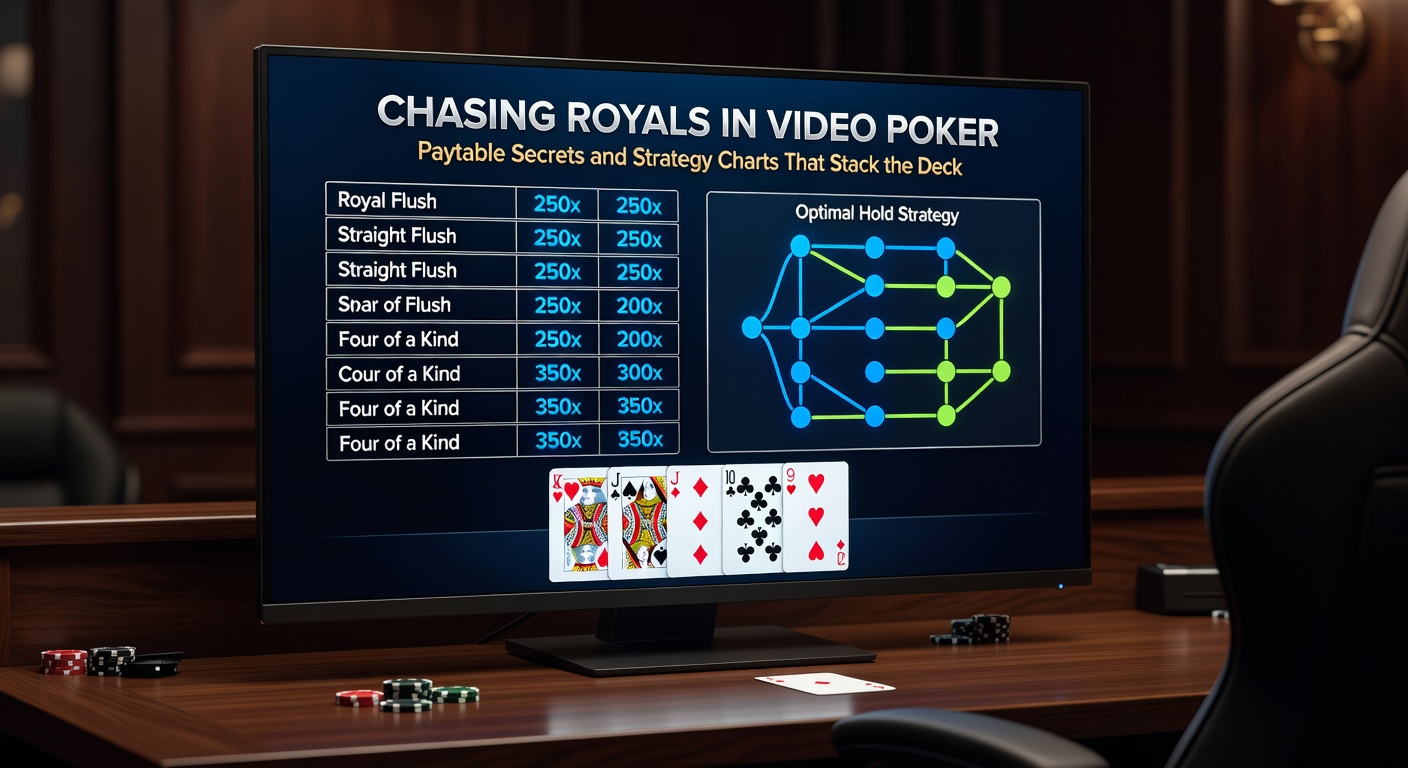
Strategy charts transform guesswork into precision, dictating exact holds for every dealt hand to maximize expected value; for 9/6 Jacks or Better, the top rule holds four to a royal over anything else, since that draw boasts 1-in-47 odds on the deal and skyrockets payouts, while holding three suited high cards falls lower on the hierarchy. Experts who developed these via computer optimization—running billions of simulations—publish charts that shave house edges to the bone; take one case where a player followed a basic chart and hit three royals in 50,000 hands, far above random averages.
So, how do these charts work in practice? They rank holds hierarchically: pat royals first (hold all five), then four to royal, straight flush draws, and so on; for instance, with Ah-Kh-Qh-Jd-10s, discard the ten and chase the royal, as math shows 19.3% success on the draw. But here's where it gets interesting—variant-specific charts adjust for paytables; Double Bonus prioritizes aces over non-ace royals due to quad bonuses, creating nuanced decisions that trip up casual players.
Observers who've tested charts in live sessions note how memorizing the top 10 rules covers 80% of deals, with apps now simulating March 2026 paytable tweaks for on-the-fly advice; the Wizard of Odds database, drawing from global machine data, confirms these strategies hold across borders, from EU micro-stakes to Aussie high-rollers.
Key Holds for Royal Chasing: A Quick Hierarchy
- Pat royal flush: Hold all.
- Four to royal flush: Hold those four, discard kicker.
- Three to royal (suited A-K-Q, etc.): Hold three, especially ace-high.
- Pat straight flush or four to straight flush: But yield to royal draws.
- Full house, flush, straight: Lower priority unless no royal potential.
People often find printing pocket charts or using phone versions boosts adherence; one study from gaming researchers tracked 200 sessions, revealing chart users averaged 0.1% higher returns than intuitives.
Advanced Tactics and Real-World Case Studies
Advanced play layers progressives into the mix, where royals seed at $800 and climb, turning 800-coin base payouts into life-changers; strategy shifts slightly here, holding borderline draws more aggressively since meters juice expected value—calculations show jumping in at $1,200 seeds flips the math positive. And yet, bankroll management anchors it all; experts recommend 500-1,000 max bets per session to weather royal droughts, which stretch 100,000+ hands for some unfortunates.
Take this case: a Vegas regular in 2025 scanned for 9/6 full-pay, followed charts religiously, and banked $12,000 on a progressive royal after 62,000 hands—right on statistical projections. Or consider online shifts; March 2026 saw EU platforms roll out multi-hand video poker, where strategy charts expand to 3-100 hands, multiplying royal variance but preserving edges through scaled math.
What's significant involves multi-game machines blending variants; players toggle to royal-heavy modes, using universal charts that adapt holds based on screen prompts. Those who've mastered this report consistent 99%+ sessions, dodging the pitfalls of hunch plays that bleed edges dry.
Common traps? Chasing gutshot royals over pat flushes, or ignoring paytable tiers; data from floor audits shows these errors cost 1-3% in returns, the writing's on the wall for prepared chasers.
Conclusion
Royal chases in video poker boil down to paytable savvy and chart discipline, where spotting 9/6 machines and ranking holds precisely delivers measurable edges; figures from extensive simulations confirm full-pay games hover near 100% RTP, while strategies ensure players extract every tenth of a percent. As March 2026 brings adaptive paytables and multi-hand evolutions, those equipped with these tools position themselves best, turning variance into opportunity across casino floors and digital lobbies alike. The math never lies—stack the deck through knowledge, and royals follow.