The Progression of Probability Modeling in Digital Baccarat and Backgammon Games
Kai Neumann · Jun 25, 2026
The Progression of Probability Modeling in Digital Baccarat and Backgammon Games
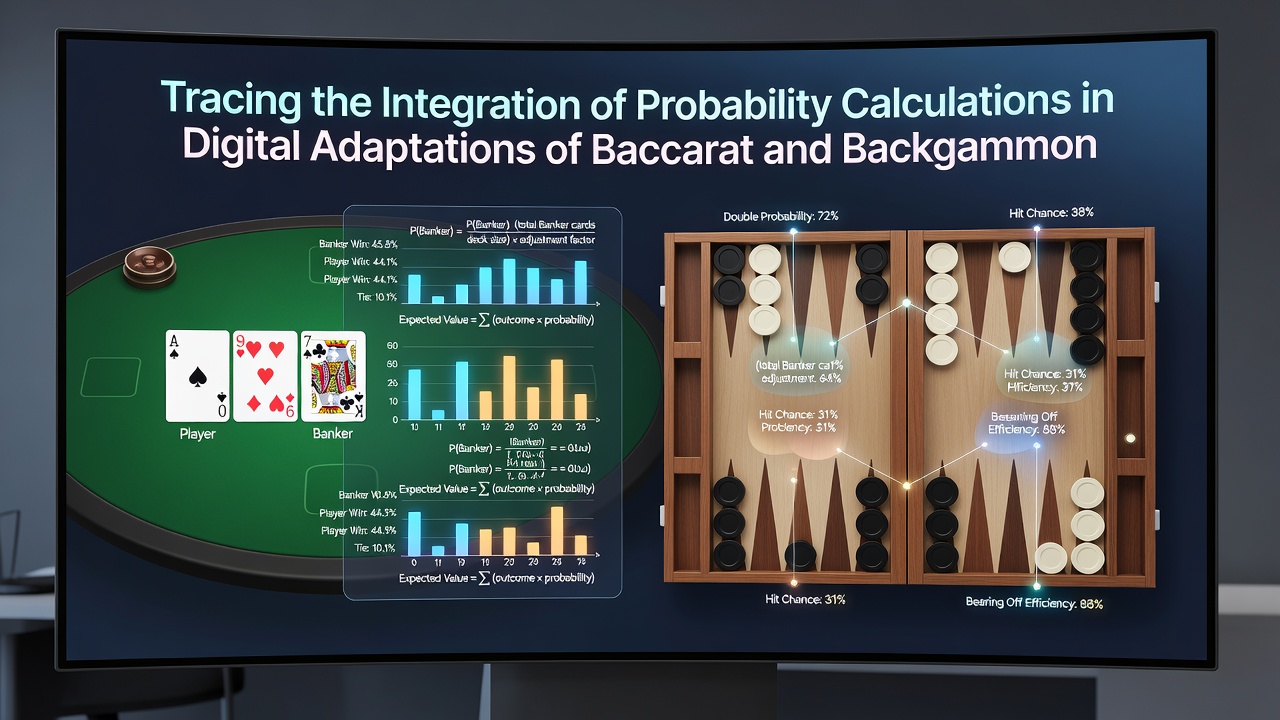
Digital adaptations of baccarat and backgammon began incorporating probability calculations as soon as computing hardware allowed random number generation and outcome simulation in the late twentieth century, and those systems have evolved through successive layers of algorithmic refinement since then. Baccarat relies on fixed drawing rules that lend themselves to straightforward combinatorial analysis, whereas backgammon introduces variable dice outcomes and positional strategy that demand dynamic evaluation of branching possibilities during each turn.
Early Computational Foundations
Initial software versions of both games appeared on personal computers in the 1980s and used basic pseudorandom functions to replicate card shuffles or dice rolls; developers quickly recognized that simple linear congruential generators could produce sequences whose statistical properties matched physical expectations over thousands of trials. Researchers at institutions studying game theory examined these implementations and confirmed that expected values for banker and player bets in baccarat aligned with theoretical percentages once the finite deck composition was accounted for in the code.
Backgammon programs from the same era introduced move-evaluation routines that tallied probabilities across all 21 possible dice combinations on each roll, allowing the computer opponent to select actions that minimized the opponent’s winning chances. Those early routines already contained the seeds of later neural-network approaches because they stored precomputed equity tables for common board configurations.
Regulatory Standards and Certified Randomness
By the 1990s, jurisdictions that licensed electronic gaming required independent laboratories to verify that random number generators passed chi-square and serial-correlation tests before any title received approval. The Nevada Gaming Control Board published technical standards that explicitly addressed the mapping of random outputs to card ranks and dice faces, ensuring that digital baccarat shoes and backgammon dice maintained uniform distributions. Similar requirements later appeared in frameworks issued by the Malta Gaming Authority and the Australian Communications and Media Authority, each referencing the same underlying statistical criteria.
Advances in Algorithmic Integration
Modern platforms integrate probability calculations at multiple stages of game execution rather than only at the random-generation layer. In digital baccarat the software maintains a running count of remaining cards when multi-deck shoes are used, recalculates conditional probabilities after every draw, and adjusts the display of side-bet odds accordingly. Real-time updates occur within milliseconds because the combinatorial formulas remain simple enough to evaluate on standard server processors.
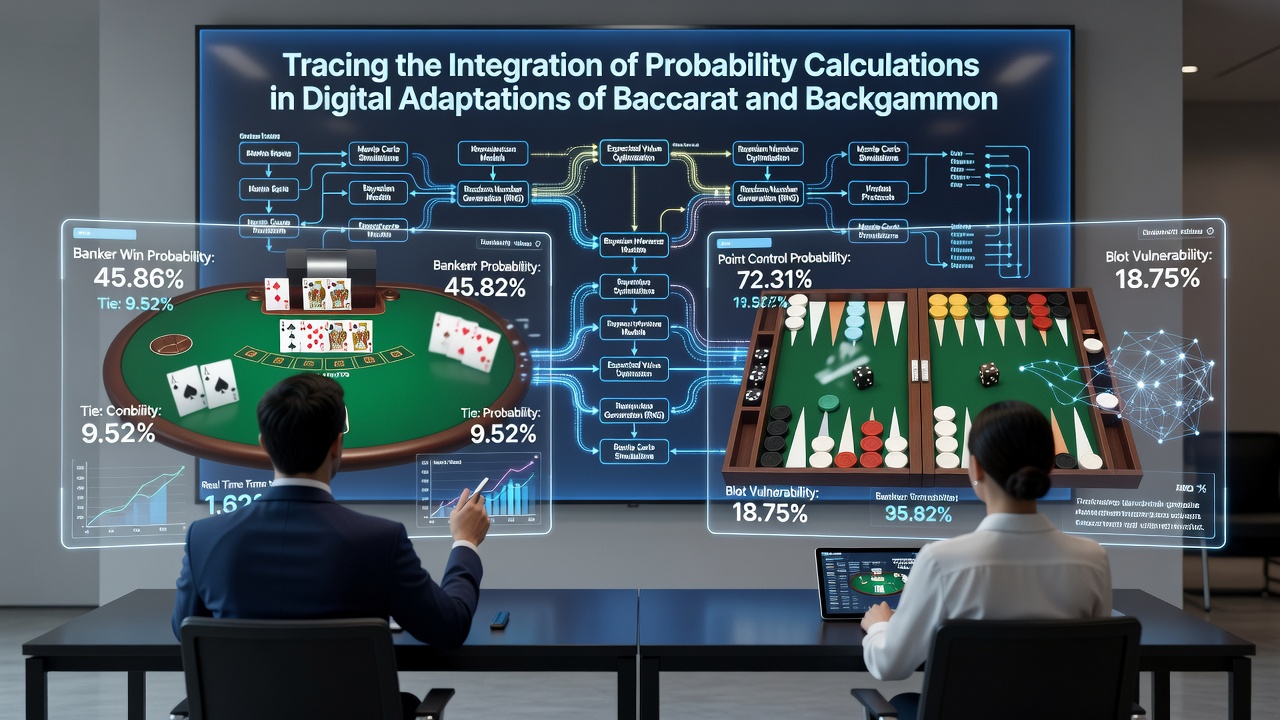
Backgammon implementations embed deeper search trees that combine the immediate dice probabilities with lookahead evaluation of subsequent rolls. Contemporary programs employ reinforcement-learning models trained on billions of self-play games; each position carries an equity value expressed as a percentage likelihood of winning from that state, and these values update continuously as new information arrives from the current roll. The same models allow developers to test rule variants by rerunning large Monte Carlo batches and comparing win-rate distributions against baseline data.
Certification and Ongoing Testing
Testing laboratories continue to perform periodic audits that sample millions of game cycles and compare observed frequencies against theoretical probabilities. Reports issued in 2025 by firms operating under the auspices of the International Association of Gaming Regulators documented pass rates above 99.8 percent for both baccarat and backgammon titles submitted for certification. Scheduled updates to testing protocols are slated for June 2026 to incorporate new entropy-source requirements for cloud-hosted random generators, reflecting advances in hardware security modules used by major platform providers.
Current Industry Practices
Operators now publish aggregate return-to-player figures derived from probability models rather than from limited live samples, and these figures are cross-checked against live data feeds that accumulate over millions of rounds. Academic groups have published open datasets of anonymized backgammon match logs that researchers use to validate equity calculations produced by commercial engines, thereby creating an external reference point for fairness claims.
Conclusion
The integration of probability calculations into digital baccarat and backgammon has progressed from basic pseudorandom mapping to layered systems that combine certified randomness, real-time combinatorial evaluation, and machine-learning equity assessment. Regulatory bodies across multiple jurisdictions maintain consistent statistical benchmarks while the underlying algorithms continue to incorporate additional data streams and faster evaluation methods. These developments ensure that electronic versions preserve the mathematical structure of the original table games while operating at the scale and speed demanded by contemporary platforms.