Rule Adjustments and Their Influence on Expected Returns in Multi-Deck Digital Card Simulations
Eden Wolf · Aug 20, 2026
Rule Adjustments and Their Influence on Expected Returns in Multi-Deck Digital Card Simulations
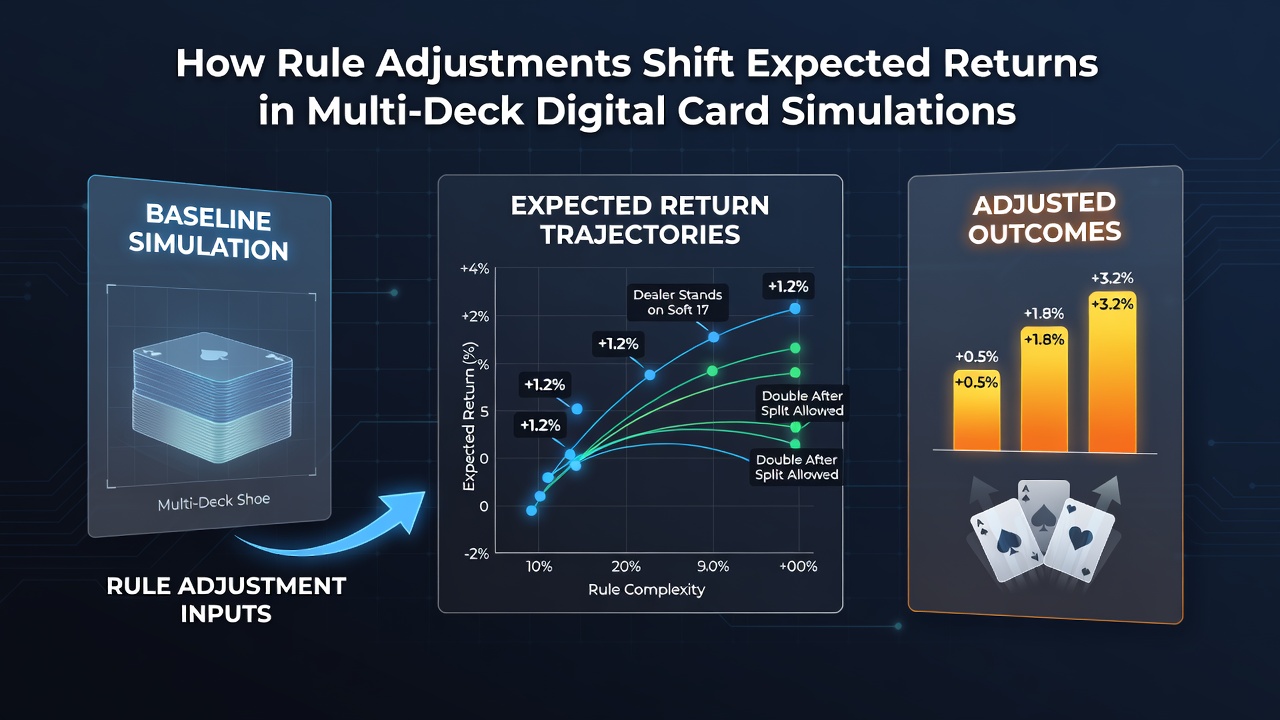
Digital card simulations rely on precise modeling of multi-deck setups where even small rule changes alter the mathematical expected returns over thousands of hands. Researchers at institutions such as the University of Nevada, Las Vegas have documented how variations in deck count, dealer procedures, and player options shift the overall return percentages in controlled environments. These adjustments appear regularly in software used by operators who run RNG-based games across multiple jurisdictions.
Core Mechanics in Multi-Deck Simulations
Multi-deck configurations typically range from two to eight decks in blackjack-style simulations, and each additional deck modifies the frequency of certain card combinations while diluting the impact of removed cards. Data from repeated runs shows that moving from a two-deck to a six-deck shoe increases the baseline house advantage by roughly 0.4 percent when all other rules remain constant. Observers note that simulation engines recalculate probabilities after every rule toggle, producing updated return figures that operators then apply to live digital tables.
Penetration rates, which determine how far into the shoe the dealer deals before reshuffling, interact directly with deck count. Shallower penetration in eight-deck games reduces opportunities for card counting strategies, and simulation outputs reflect lower expected returns for players under those constraints. In August 2026 several simulation platforms incorporated updated penetration parameters drawn from regulatory reporting in North American markets, leading to revised return tables that reflected tighter shuffle points.
Dealer Rule Variations and Return Shifts
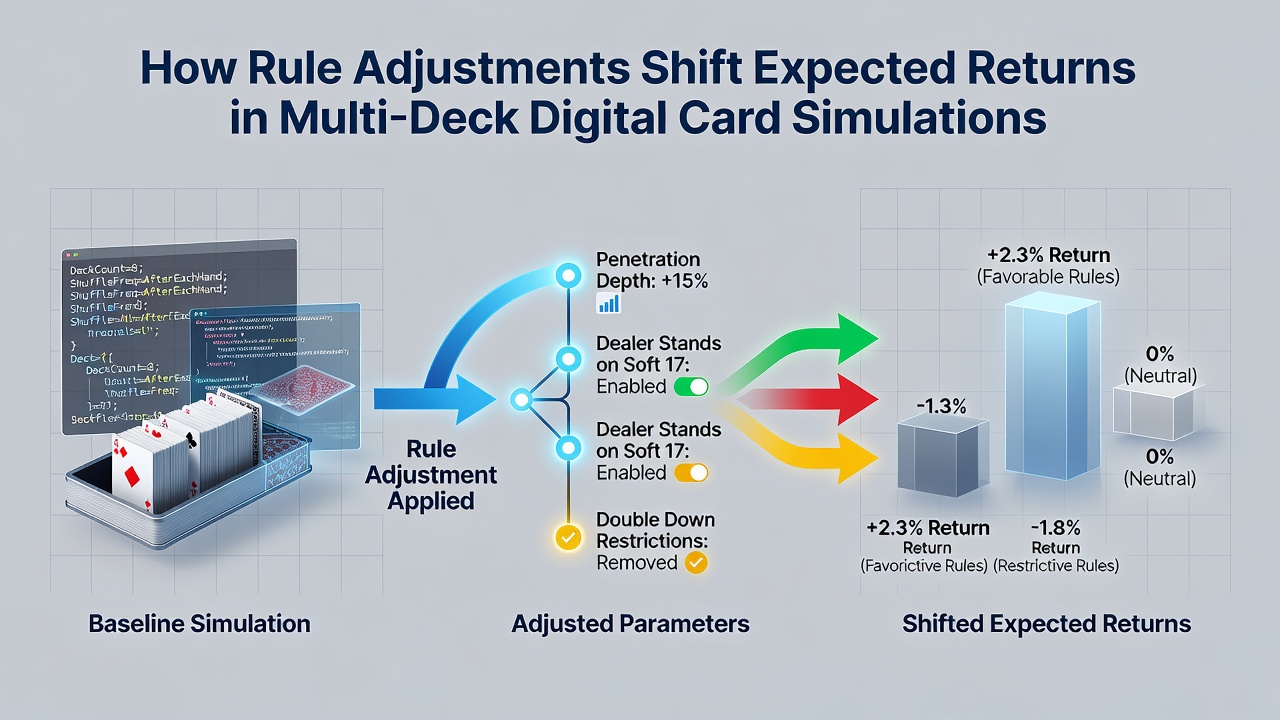
Dealer standing rules on soft seventeen produce measurable differences in player expected returns. When the dealer hits soft seventeen the house edge rises by approximately 0.2 percent compared with standing rules, according to aggregated simulation data across millions of hands. This adjustment appears consistently across both two-deck and eight-deck models, though the absolute impact grows slightly larger in deeper shoes because more hands reach the soft seventeen decision point.
Other dealer procedures such as peek rules for blackjack and restrictions on splitting or resplitting further modify outcomes. Simulations that disable dealer peeking show an additional 0.1 percent shift in expected returns, while allowing players to resplit aces up to four hands narrows the house advantage by a smaller margin. These changes compound when multiple rules adjust simultaneously, which is why operators run fresh simulation batches after each regulatory update.
Player Option Adjustments
Double-down restrictions and surrender availability create additional layers of variation. Simulations that permit doubling after splits record player returns that improve by 0.15 to 0.25 percent depending on the number of decks in play. Late surrender options, when enabled, reduce the house edge by roughly 0.08 percent in six-deck and eight-deck models while showing a smaller effect in two-deck games where fewer hands reach the surrender decision.
Insurance and even-money rules also register in the data. Turning off insurance entirely shifts expected returns upward for players who would otherwise take the bet at suboptimal times. Researchers running parallel simulations with and without insurance have recorded consistent differences that operators then translate into game configuration files for digital platforms.
Comparative Data Across Jurisdictions
Reports from the Nevada Gaming Control Board and the Australian Communications and Media Authority both highlight how rule standardization affects simulated returns in multi-deck environments. One study released in early 2026 compared eight-deck configurations under differing surrender rules and found that the presence of early surrender improved player expected returns by 0.4 percent over late surrender alone. These findings prompted several software providers to adjust default settings in their simulation suites during the summer of that year.
Turnout from those updates appears in ongoing monitoring data released by the same agencies. The figures reveal that games configured with the newer rule sets maintain stable return percentages across extended test cycles, confirming that the mathematical models hold when rule parameters change in controlled increments.
Conclusion
Rule adjustments in multi-deck digital card simulations produce predictable shifts in expected returns that operators track through repeated testing cycles. Deck count, dealer procedures, and player options each contribute measurable increments to the overall return percentage. Regulatory bodies in multiple regions continue to reference simulation outputs when reviewing game configurations, ensuring that published return figures align with the underlying mathematical models. Continued refinement of these simulation parameters supports consistent player return data across digital card offerings.