Mathematical Frameworks in Virtual Poker Variants and Their Effects on Extended Play Sessions
Cameron Baumann · Aug 20, 2026

Mathematical Frameworks in Virtual Poker Variants and Their Effects on Extended Play Sessions
Virtual poker variants rely on established statistical frameworks that determine card distribution patterns and outcome probabilities across thousands of simulated hands, and these systems shape how sessions unfold over extended periods because players encounter predictable ranges of results based on the underlying algorithms. Data from gaming laboratories shows that random number generators certified under strict testing protocols produce sequences that mirror physical shuffles while maintaining consistent return-to-player percentages across variants such as Texas Hold'em, Omaha, and video poker formats.
Core Components of RNG Certification and Probability Mapping
Regulatory bodies in multiple jurisdictions require independent verification of RNG software before deployment, and laboratories examine the uniformity of number sequences along with the absence of detectable patterns that could skew long-term distributions. Figures from the Nevada Gaming Control Board indicate that certified systems undergo millions of test cycles annually, which confirms that each card draw maintains equal probability regardless of previous outcomes or session length.
Researchers at academic institutions have mapped expected value calculations for common virtual poker paytables, revealing how slight adjustments to bonus multipliers or hand rankings alter the mathematical house edge over millions of hands. These models incorporate variance measurements that help explain why short sessions can deviate sharply from theoretical returns while longer play converges toward the programmed percentages.
Variant-Specific Models and Their Structural Differences
Texas Hold'em simulations employ community card algorithms that calculate equity in real time using combinatorial mathematics, whereas video poker variants rely on fixed paytable structures that allow precise computation of optimal strategy through exhaustive enumeration of all possible draws. Studies published by the University of Nevada, Las Vegas gaming research program demonstrate that multi-hand video poker formats introduce additional layers of covariance between simultaneous hands, which affects bankroll volatility during extended sessions.
Omaha variants add further complexity because players receive four hole cards instead of two, expanding the number of possible combinations and requiring Monte Carlo simulation methods to estimate win rates accurately when multiple opponents remain in a hand. Observers note that these computational demands lead operators to pre-calculate lookup tables for common scenarios, ensuring that real-time play remains responsive without compromising the integrity of the probability engine.
Long-Term Play Dynamics and Bankroll Interaction
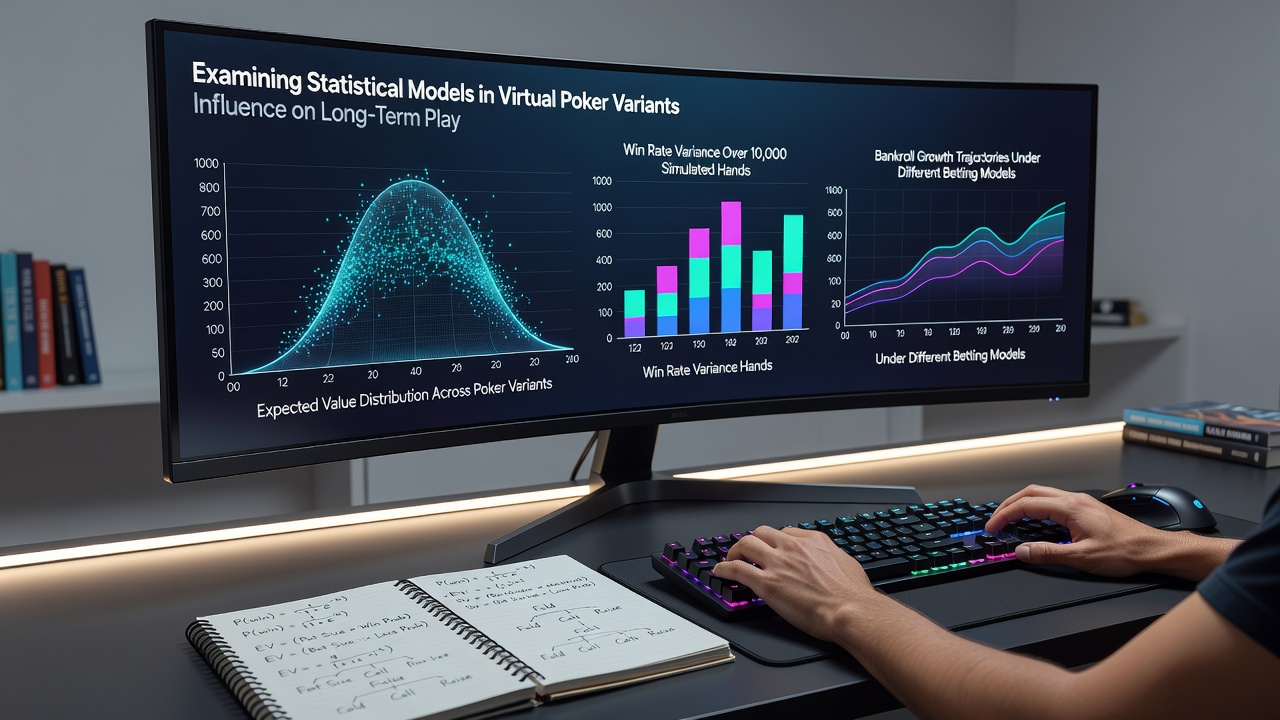
Statistical models directly influence how players experience drawdowns and upswings because variance parameters embedded in each variant determine the frequency and magnitude of deviations from expected returns. Data compiled across regulated markets shows that high-variance formats produce longer periods of negative results followed by larger positive corrections, which in turn affects decisions about session length and stake adjustments.
Those who have analyzed extensive hand histories find that players who track their results against theoretical models often adjust their participation patterns, extending sessions during favorable variance streaks while shortening them when results align with negative expected value periods. Certification standards updated in August 2026 introduced enhanced reporting requirements for operators, mandating disclosure of variance metrics alongside standard RTP figures so that participants receive clearer information about potential session fluctuations.
Regulatory Oversight and Model Validation Practices
Gaming authorities across North America and Australia require periodic re-testing of deployed RNG systems to confirm that software updates have not introduced unintended biases, and these audits include both statistical sampling and full source code reviews. Industry reports from the Canadian Gaming Association highlight how continuous monitoring tools now track millions of hands in real time, flagging any statistical anomalies that exceed predefined thresholds.
Academic papers examining player behavior datasets reveal correlations between exposure to different variance profiles and changes in session duration, although causation remains difficult to isolate from individual risk preferences. These findings feed back into model refinements as operators seek to balance mathematical fairness with engagement metrics that sustain long-term participation.
Conclusion
Statistical models underpin every aspect of virtual poker operation from initial card distribution through final payout calculations, and their influence on long-term play manifests through measurable patterns in outcome distribution and bankroll movement. Continued validation by independent laboratories together with evolving regulatory standards ensures that these frameworks remain transparent and consistent across jurisdictions, providing participants with predictable mathematical environments regardless of session length or variant selection.